3 June 2026
AI Says Yes Where the Film Industry Says No
The real question about generative AI in film is not whether it can make images. It is whether the film industry can survive the loss of the gate marked no.
Tribeca has accepted Dreams of Violets, a feature-length AI-generated docudrama by Ash and Pooya Koosha, for a world premiere at its 2026 festival. Set around political violence in Iran, the film is described by its producers as a fictional dramatization based on journalistic reports, photographs and eyewitness accounts. Every image and every person in the film is AI-generated, and it was reportedly produced in two months for less than $2,000 (Business Wire, 2026).
The defensiveness around the film is almost as interesting as the film itself. Its makers have not merely argued that AI made the work cheaper or faster. They have suggested that, given the dangers, restrictions and lack of access surrounding the subject matter, AI may have been the only way the film could exist at all.
This is where the familiar refrain returns: film is art.
It is said as if it settles the matter. Film is art, therefore the old methods are sacred. Film is art, therefore synthetic images are trespass. Film is art, therefore cinema must remain off limits to generative AI.
But “film is art” is not really an argument; it is a declaration of belief. It tells us very little about what films are, how they function, who gets to make them, or why so many stories never reach the screen.
Narrative cinema is, before anything else, storytelling. It may contain art, and it may become art, but its basic engine is drama: someone wants something, something gets in the way, and the audience is invited to care.
If filmmaking were simply art in the narrow sense often implied by its defenders, why are so many films adapted from novels, memoirs, journalism and plays rather than paintings? Why is the governing document of a film a script rather than a sculpture? Why does production begin with scenes, characters, dialogue, beats and reversals rather than with an object on a plinth?
This is not to diminish cinema. It is to take it seriously. Film is not one art form. It is a volatile coalition of craft, technology, labour, money, storytelling, performance, distribution and imagination. It is a cathedral and a factory. It is a dream and a payroll.
Having spent time at an arts university, I came away less certain about what the word “art” means. Not because it is empty, but because it is often used so broadly that it can become a way of avoiding thought. Morris Weitz argued that art is an “open concept”, resistant to any final definition (Weitz, 1956). Arthur Danto later suggested that something becomes visible as art through the interpretive world around it: the theories, institutions and histories that allow it to be seen that way (Danto, 1964). “Art”, in other words, has never been as fixed or self-evident as people like to pretend.
What I do know is that art and artifice belong together. Artifice comes from roots associated with workmanship, craft and skill before acquiring its later sense of trickery (Harper, n.d.). That tension is exactly where cinema lives. Film is artifice: the deliberate construction of an illusion in which the audience agrees, for a while, to believe.
That relationship is not degraded by technology. It is only possible because of it. The camera is a technology. So is editing. So is sound recording. So are visual effects.
Theatre asked us to believe the painted flat. Silent cinema asked us to believe flickering light. Sound cinema asked us to believe synchronised voices. Editing asked us to believe that two shots filmed apart occupied the same emotional instant. CGI asked us to believe in dinosaurs, planets, ghosts and resurrected cities. Generative AI is another technology of artifice.
That does not make it ethically neutral. The questions are real, especially in docudrama, where synthetic images can borrow the emotional authority of evidence. But the presence of ethical questions does not make AI inherently illegitimate. The more interesting question is not whether AI films are art, but why so many people are invested in saying they are not.
At Cannes this year, that anxiety and curiosity were everywhere. AI company Higgsfield presented Hell Grind, a 95-minute AI-generated action-fantasy feature reportedly made by a 15-person team in Kazakhstan in around 14 days for about $500,000, most of it spent on compute (Foley, 2026). It is important to be precise: the film did not premiere in the official Cannes Film Festival programme. It appeared at a side event near the festival, within the orbit of the world’s most symbolically powerful film market.
That distinction consequential. Tribeca represents the official door opening. Cannes represents the perimeter shifting. One is selection; the other is signal. Together they show that AI in filmmaking is no longer a speculative panel topic. It is entering festivals, markets, industry events, trailers, deal conversations and production slates.
The Guardian reported that AI dominated Cannes this year, from beach summits to yacht events, with figures including Darren Aronofsky, Steven Soderbergh, Demi Moore, Peter Jackson, Guillermo del Toro and Seth Rogen all drawn into arguments about whether AI expands the cinematic toolbox or threatens human creativity (Khomami, 2026).
This debate becomes more concrete when you have projects of your own waiting to be made.
We arrived in Cannes this year with teasers for two of ours: The Casebook of Morgan Elliot: The Sign of Three and The Broken Heart. Without AI, both would almost certainly still be trapped in development. These are not stories we invented because AI appeared. They had been sitting on the shelf for years. AI did not give us the stories. It gave us a route to production.
For years, the film industry has operated as though a story does not fully exist until someone with money recognises it. You can write the script, build the world, know the characters and carry the film in your head for a decade. But until the right gatekeeper says yes, the story remains invisible.
AI does not make the work easy. It makes invisibility harder to enforce.
For the first time, many of us can say plainly what has long been true: the film industry is a deeply exclusive club. Not merely competitive. Structurally exclusive. It is built around scarcity: scarcity of finance, scarcity of introductions, scarcity of trusted names, scarcity of access, scarcity of permission.
The evidence for this is not anecdotal. Research by the Creative Industries Policy and Evidence Centre and ScreenSkills found that in 2020, 53% of people working in the UK screen industries came from privileged backgrounds, compared with 38% across the wider workforce. In key creative roles such as writers, producers and directors, that figure rose to 61% (Carey et al., 2021). ScreenSkills summarised the same research by noting that only a quarter of UK screen workers came from working-class backgrounds (ScreenSkills, 2021). In the United States, the USC Annenberg Inclusion Initiative found that women directed only 6.6% of directors across 1,800 top-grossing films from 2007 to 2024, while underrepresented women accounted for just 1.7% of directors in the sample (Smith and Initiative, 2026).
So when people say AI threatens cinema, I want to ask: whose cinema?
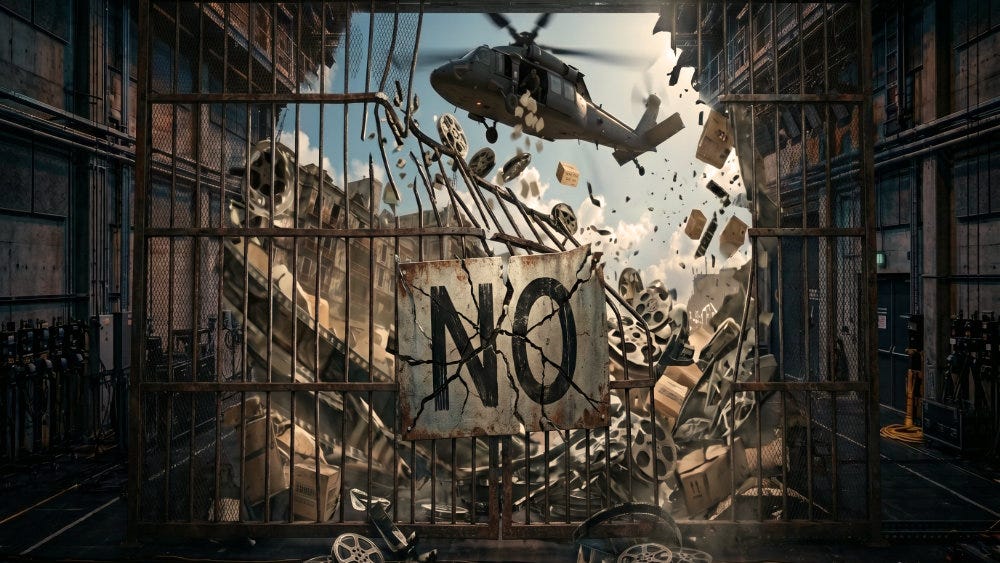
The industry is built on the word no.
No, you do not have the experience.
No, you do not have the budget.
No, you do not have the right attachments.
No, you cannot access that actor.
No, you cannot afford that world.
No, the market is not looking for this.
No, the audience is not ready.
No, come back when someone else has already said yes.
Many of us have stories we have wanted to make for years: not vague ideas, but scripts, treatments, characters, worlds. Films we could pitch but not green-light. Films that existed everywhere except on screen.
AI offers a means to challenge that.
That does not mean AI has democratised cinema. I am wary of that word. “Democratisation” often sounds radical while leaving structures of visibility, capital and distribution intact. A cheaper tool does not automatically redistribute power. A phone camera did not make everyone a cinematographer. A laptop did not make everyone a novelist. A TikTok account did not make everyone a storyteller worth watching.
Professional storytelling requires skill, craft, experience and a lot of practice. A film worth paying attention to needs structure, rhythm, emotional intelligence, restraint, visual judgement, pacing, tone, sound, world-building, a point of view and a reason to exist. AI does not abolish craft. If anything, it makes the absence of craft more visible.
This distinction matters because the loudest arguments about AI often confuse access with quality. They assume that if more people can make images, fewer good images will exist. The history of media suggests something more complicated. New tools create floods of mediocrity; they also create new languages and new stories. They allow people previously locked out of production to test themselves against audiences rather than against the prejudices of a financing committee.
The fear, of course, is jobs.
A colleague of mine who teaches film often says that no child, when asked what they want to be when they grow up, says “focus puller”. It is a funny line because it is true, but it points to something serious. The film industry is made of thousands of highly skilled workers whose labour is largely invisible to audiences.
Those workers are right to be anxious. If studios use AI simply to reduce payroll while protecting executive profit, the result will not be liberation. It will be erasure.
The unions understood this early. The Writers Guild of America’s 2023 agreement established that AI is not a writer and cannot be used to undermine writers’ credit, compensation or separated rights (WGAW, 2023). SAG-AFTRA’s agreement addressed digital replicas, consent, compensation and the risk that AI could be used to circumvent the engagement of human performers, including background actors (The Authors Guild, 2024). The International Labour Organization has similarly argued that generative AI is more likely to automate tasks than entire occupations, while warning that policy, job quality and fair transitions will be decisive (Gmyrek et al., 2023).
The fear is not unfounded. But it is incomplete.
When independent filmmakers use AI to make films that would never otherwise have existed, whose job has been taken? If the alternative was not a traditionally crewed production but no production at all, then the lost job is imaginary. There was no crew waiting by the phone. No set was shut down. No costume department was dismissed. No focus puller was replaced. There was simply a body of work that could not cross the threshold into production.
You cannot lose what never existed.
That does not absolve those using AI in their filmmaking of responsibility. It does not mean every use is ethical. It does not mean that training data, consent, likeness rights, voice cloning, authorship or labour displacement can be waved away. In docudrama especially, where audiences are asked to feel the weight of real events, synthetic images demand transparency. Viewers should know what is reconstructed, what is sourced, what is imagined and what is evidenced.
But we need to distinguish between two very different things: a corporation replacing a crew it could afford to hire, and an excluded filmmaker using AI to enter a room that was locked.
That is why Dreams of Violets is important, whatever one eventually thinks of the film itself. That is why Hell Grind matters, even if its greater importance may lie in proving a pipeline rather than delivering a masterpiece. And that is why arriving in Cannes with teasers for Morgan Elliot and The Broken Heart mattered to us.
AI did not make us filmmakers. It did not write our taste, judgement, politics, anxieties or sense of story. It did not remove the need to understand what a scene is doing or why an audience should care. What it did was remove one layer of refusal.
There will be bad AI films. There will be lazy AI films. There will be cynical AI films. There will be AI films that imitate rather than imagine. But there are already bad human films, lazy human films, cynical human films and expensive human films that imitate rather than imagine. Bad work is not a new problem. It is the normal condition from which good work occasionally emerges.
The mantra “film is art” asks us to protect cinema by protecting its old rituals. I am less interested in rituals than in results.
Does the film move us?
Does it think?
Does it reveal something?
Does it create a believable artifice through which the imagination can travel somewhere new?
If yes, then AI is not the scandal.
The scandal is how long we were told “no”.
And once films that “could not be made” begin to get made, something else happens. Proof appears. Audiences appear. Collaborators appear. Budgets appear. Jobs appear.
The film industry has always confused permission with quality. AI breaks that confusion. It does not make everyone a filmmaker, and it does not make every film worth watching. But it makes the first answer less likely to be no.
For a medium built on artifice, that feels less like a threat to cinema than a return to its oldest promise:
Show us something we could not otherwise see.
References
Carey, H., O’Brien, D. and Gable, O. (2021). Screened out: Tackling class inequality in the UK screen industries. London: Creative Industries Policy and Evidence Centre and ScreenSkills [online]. Available from: https://pec.ac.uk/wp-content/uploads/2023/09/PEC-and-ScreenSkills-report-Screened-Out-FINAL-April-2021.pdf [Accessed 28 May 2026].
Danto, A.C. (1964). The artworld. The Journal of Philosophy. Vol. 61 No. 19. pp. 571–584 [online]. https://doi.org/10.2307/2022937.
Foley, J. (2026). ‘The future is one person making a whole film,’ says director of AI movie that hijacked Cannes [online]. Available from: https://www.creativebloq.com/ai/the-future-is-one-person-making-a-whole-film-says-director-of-first-ai-movie-at-cannes [Accessed 28 May 2026].
Gmyrek, P., Berg, J. and Bescond, D. (2023). Generative AI and jobs: A global analysis of potential effects on job quantity and quality. ILO working paper. Geneva: International Labour Office [online]. Available from: https://www.ilo.org/sites/default/files/2024-07/WP96_web.pdf [Accessed 28 May 2026].
Harper, D. (n.d.). Artifice [online]. Available from: https://www.etymonline.com/word/artifice [Accessed 28 May 2026].
Khomami, N. (2026). ‘We’re expanding the cinematic toolbox’: AI fault lines on show at Cannes [online]. Available from: https://www.theguardian.com/technology/2026/may/24/cinematic-toolbox-ai-fault-lines-cannes [Accessed 28 May 2026].
ScreenSkills (2021). New research shows only quarter of screen workers are from working-class backgrounds [online]. Available from: https://www.screenskills.com/news/new-research-shows-only-quarter-of-screen-workers-are-from-working-class-backgrounds/ [Accessed 28 May 2026].
Smith, S.L. and Initiative, A.I. (2026). Inclusion in the director’s chair? Los Angeles: USC Annenberg Inclusion Initiative [online]. Available from: https://aii.annenberg.usc.edu/reports [Accessed 28 May 2026].
The Authors Guild (2024). SAG-AFTRA agreement establishes important safeguards for actors around AI use [online]. Available from: https://authorsguild.org/news/sag-aftra-agreement-establishes-important-ai-safeguards/ [Accessed 28 May 2026].
Weitz, M. (1956). The role of theory in aesthetics. The Journal of Aesthetics and Art Criticism. Vol. 15 No. 1. pp. 27–35 [online]. https://doi.org/10.2307/427491.
WGAW (2023). Summary of the 2023 WGA MBA [online]. Available from: https://origin.www.wga.org/Content/Page [Accessed 11 January 2026].
 Facebook
 LinkedIn
 Instagram